

 Loading...
ESK Science Fair Winners Find Answers to Life’s Vexing Problems
Ingenuity and the spirit of fun helped 11 Episcopal School of Knoxville students find startling solutions to common problems, earning them berths at Southern Appalachian Science and Engineering Fair at the University of Tennessee March 26.
 |
| Sixth Grader Jamie Hickling was grand prize winner at the ESK Middle School Science Fair |
|
|
|
First place winners selected to exhibit at the Southern Appalachian Science and Engineering Fair are (front row, l-r) George NeCastro, Ellie Lai, Jamie Hickling, Grace Taylor; (back row, l-r) Peter Cooper, Steven Busby, Alex Daley, Florentin Kunz, and Mary Emily Lauver. |
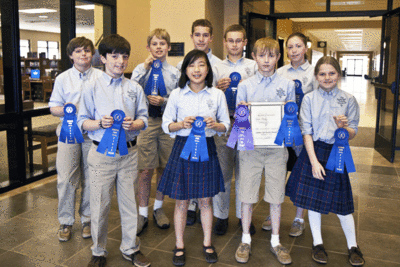
The students were first place winners at the ESK Middle School Science Fair Feb. 23, where 85 students who had worked on their projects since Thanksgiving competed in six categories – Behavioral Science, Chemistry, Life Science, Physics, Sports Science, and Technology. Among their findings:
--The “five-second” rule about food dropped on the floor is not true. Bacteria transfer happens almost immediately.
--Listening to music does not impede memory in Middle School students. It improves concentration.
--You can dramatically speed up the cooking time of beans by adding a certain common ingredient (baking soda) to the liquid.
--Both light and gravity determine the direction that plant stems grow, but roots respond only to gravity.
Sixth grader Jamie Hickling was grand prize winner for his project, “What’s Up?”, which studied the effect of light and gravity on the direction that plants grow. He found that both light and gravity determine the direction that plant stems grow, but that roots respond only to gravity.
Jamie grappled with problems like finding a light source to mimic the sun and dealing with an initial set of test plants that all died.
“Originally I planted beans in cotton balls, but the plants all died,” said Jamie, guessing that some bleaching agent in the manufacture of the cotton balls may have been toxic to the seedlings. He switched to planting cress seeds in soil wrapped with mesh, suspended in bottles to regulate the humidity. The seedlings thrived.
Other first place winners and the problems they will ponder at the SASEF:
Steven Busby -- Will people’s memory for strangers decrease if the strangers wear different clothes? (Answer: Sometimes)
George Necastro – Does music affect scores on a memory test? (Answer: It helps students concentrate)
Ellie Lai -- What type of orange juice container retains the most Vitamin C? (Simply Orange in clear plastic)
Florentin Kunz – What is the best way to speed up the cooking time of dry beans? (Cook them in a water and baking soda solution)
Mary Emily Lauver – Does the length of time that a gummy bear is on a contaminated floor tile affect the amount of bacteria grown on the candy? (No, the candy is covered with bacteria almost immediately.)
Grace Taylor – How does motor oil affect water plant respiration? (It kills the plant within two hours.)
Alexis Hartwig -- Do hurricanes cool the ocean? (Weaker ones cool it more than stronger ones.)
Alex Daley – Which airsoft gun penetrates Styrofoam the farthest? (Kalashnikov AKS 74u airsoft gun)
Peter Cooper – Does flash freezing preserve produce better than conventional freezing? (No)
Middle School science teacher Cary Busby said that application of the scientific method – observation, hypothesis and testing -- to the questions that keep you up at night is a key strategy for succeeding in life.
“You can apply it in every area. You can apply it in business and marketing. Even sports. If you’ve got an athlete and something isn’t going well, you use observation, hypothesis, and testing to answer the question,” she said.