
 Loading...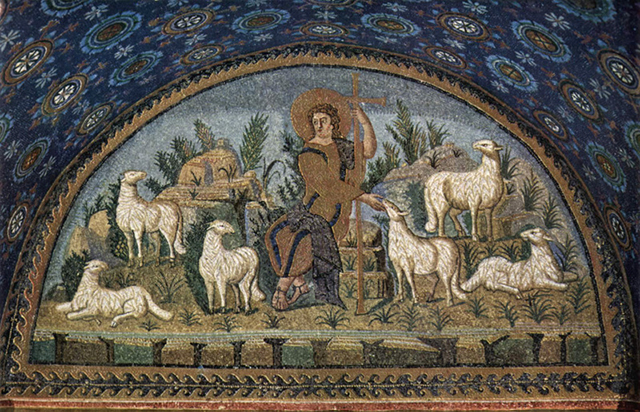
The Lord is my Shepherd; I shall not be in want. Amen.
Looking out at you, it is my assumption that most, if not all of us, have had our eyes examined. We have probably had them examined many times.
At first, there appears to be two possible outcomes from an eye examination. You may discover that your vision is exceptionally good, that you need no visual aids to assist you with sight and that no diseases of the eye affect you in anyway. If someone were to ask, you might tell them I passed the eye exam.
The second outcome is that the exam reveals vision that is limited and blurred, requiring some kind of aid to correct our sight. Glasses or contacts or surgical procedures assist those who fail the eye exam, falling well short of 20/20 vision, having no ability to tell if the second letter on the third line is a P or a D. Actually, you thought it was a B.
So, an eye exam reveals the quality of your sight and the overall health of your eye.
Now you may not have experienced this, but I believe there is also a third possible outcome when your eyes are examined.
The optometrist begins to ask you a series of rapid-fire questions, repetitive in their delivery, with the desire to confirm the kind of corrective lenses necessary to perfect your vision. “Can you see better with 1 or 2? 1 or 2? Now, this one or this one? 1 or 2? 1 or 2?”
I never worry about passing or failing the eye exam. I worry about contradicting myself.
Did I say 1 was better and now am I refuting that, suggesting 2 is better? Are they showing me different images? Is this really not an eye exam but actually an exercise to show how fickle I am, unable even to be consistent in determining just how poorly I see?
Holy Scripture can be read to us, as it is in public worship, so that we hear the story of God’s presence in the world and humanity’s response. Scripture can also be read in an individual setting, so as to consider it slowly, to meditate on it, to draw comfort or be confounded by it.
For many of us, the Scriptures are so significant that we commit portions of them to memory. When I was a child, an evangelist once visited our town whose claim to fame was that he had memorized the entire Gospel of St. Matthew. With big hair and a bad suit, the evangelist would recite large sections of the Gospel, looking just above the heads of the congregation, as if he were reading from a heavenly teleprompter.
If we took an informal poll on Biblical texts that are widely held in our collective memory, the 23rd Psalm would surely make any list, if not actually topping it. And while we read from the New Revised Standard Version in public worship, the King James version of the 23rd Psalm tends to be the version we know and recall—
The Lord is my shepherd; I shall not want.
He maketh me to lie down in green pastures: he leadeth me beside the still waters.
He restoreth my soul: he leadeth me in the paths of righteousness for his name's sake.
Yea, though I walk through the valley of the shadow of death, I will fear no evil: for thou art with me; thy rod and thy staff they comfort me.
Thou preparest a table before me in the presence of mine enemies: thou anointest my head with oil; my cup runneth over.
Surely goodness and mercy shall follow me all the days of my life: and I will dwell in the house of the Lord for ever.
Beautiful words, lovely words, comforting words.
And, for me, words of great contradiction. In the very first sentence, I am tripped up.
The Lord is my shepherd. Who wouldn’t be for that? It is assuring to consider God as a guide, a divine overseer who is present in times of trouble and knows how to find the still waters and the good land. If God is the shepherd, the capital S Shepherd, then I am not alone, not having to figure this life out on my own. The promise of the 23rd Psalm, that God is our Shepherd makes plain why it is so popular, so enduring, so right for being a passage of holy text committed to memory.
I shall not want. Are you kidding me? I want everything, and seconds after I am done. And I am not alone in that wanting. I fear we think of ourselves less as citizens of a republic, or in the life of the Church as members of a body, and more as consumers in an endless economy. Even in the life of the Church, we speak of church shopping, of substituting a commitment to a community of those trying to follow Jesus with a sacred transaction that we can, somehow, purchase the right church to fit my preferences.
Wendell Berry, in a poem entitled Manifesto: The Mad Farmer Liberation Front, captures an even deeper ailment. Not only do we want, but our wanting is not even controlled by us. When they want you to buy something, they will call you, he writes in that poem. In that world, God is not the Shepherd. Instead, we are led by the promise that our wanting can be satisfied with more wanting. But that quest never ends.
It might surprise us to realize that in our shared sense of comfort from the 23rd Psalm we have, in fact, committed a contradiction to memory. The Lord is my Shepherd. We want that to be so. Therefore, I shall not want. I don’t think we believe we can pull that off or make that declaration come true in any real sense.
In memorizing a contradiction, in understanding that while we may want God to be our Shepherd that does not necessarily mean we want to give up needless wanting, it helps greatly to realize that the essential role of sheep is to trust the Shepherd who leads.
In giving up control, in surrender, the sheep are willing to be guided by the Shepherd, by the Holy One, through lands where the waters are still and through valleys where the shadows are deep and unknown. In using the image of sheep and shepherd to convey the relationship between God and God’s people, the Psalmist recognizes that surrender, the relinquishing of our desire for the desire of God, is a daily task that we are called to practice for a lifetime.
The Lord is my shepherd; I shall not want. Keep saying it. Like a prayer, like a mantra for meditation, or a cry for help, the Shepherd’s sufficiency gives us the grace to risk the countercultural move of no longer grasping after things to satisfy what only God can do.
The words of the 23rd Psalm are words of comfort. But those words of comfort do their most powerful work when they reveal the contradictions in us. Our vision is incomplete. We do not see God truly as large and expansive as the Divine is. Because the Shepherd leads us we can let go of seeking after things that do not satisfy. Because the Shepherd holds all things together we can, over time, learn that we do not have to seek after the false idol of control.
We find our lives by losing our lives. We know how to go forward by no longer seeking to go forward on our own power. We find by following the Shepherd. In surrendering control, we find a comfort and peace that the world cannot give.
Evoking memory of the 23rd Psalm may take you back to childhood, to a kind of naïve innocence. But the words of that psalm come from a writer who had known pain and uncertainty and doubt. At the end, they confess they got through because they were led by the Shepherd , who is good and faithful and wise.
That is good news, no matter your age. Those with eyes to see, let them see.